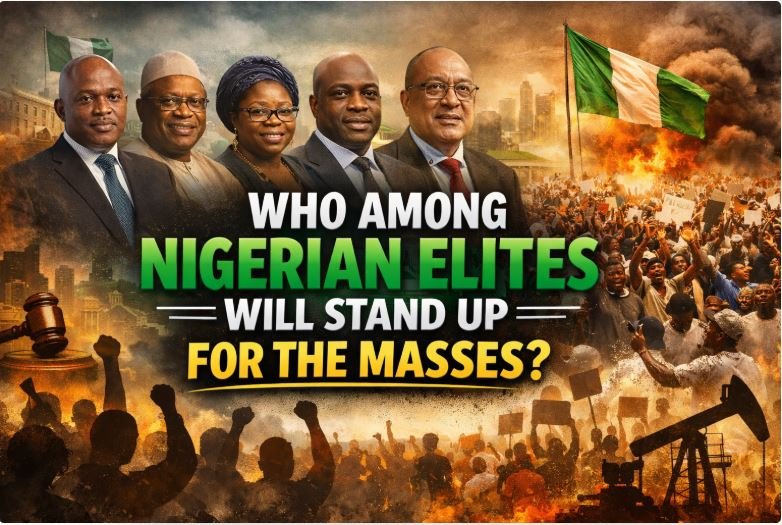
WHO AMONG NIGERIAN ELITES WILL STAND UP? True Revolutions Require An Elite Or Beneficiary From the System To Lead
WHO AMONG NIGERIAN ELITES WILL STAND UP? True Revolutions Require An Elite Or Beneficiary From the System To Lead — And Why Nigeria Needs Elite Defectors, Not Elite Spectators
Nigeria keeps waiting for “the masses” to rise and save it.
But history doesn’t support that fantasy and history is stubborn.
The poor can protest.
The poor can chant.
The poor can bleed.
But systems change when insiders defect. And the insiders are the elites.
Revolutions are not sustained by anger alone. They are engineered through leverage, access, coalition-building, institutional drafting, financial stamina, and strategic coordination.
In simple terms: The poor can ignite pressure. Elites convert pressure into structure.
Nigeria’s Own History Proves It
Let’s remove sentiment and look at structure.
Nigeria’s independence was not negotiated in marketplaces.
It was delivered through elite coordination:
- Nnamdi Azikiwe — Western-educated elite who weaponized media and nationalist organization to mobilize independence.
- Obafemi Awolowo — elite lawyer and policy architect who designed free education and institutional reform in the Western Region.
- Ahmadu Bello — aristocratic Northern elite who consolidated regional political machinery.
- Tafawa Balewa — educated political elite who navigated independence diplomacy.
The masses mattered, but elite organization delivered the state.
Revolutions require structure but Structure lives where elites operate.
Globally? The Pattern Is Identical
Across continents, over the ages, the same template repeats, with some few exceptions of course:
- Simón Bolívar (Venezuela) — aristocrat who dismantled Spanish colonial rule across South America.
- Mahatma Gandhi (India) — elite-educated lawyer who mobilized millions against empire.
- Jawaharlal Nehru (India) — wealthy elite who shaped post-colonial governance architecture.
- Nelson Mandela (South Africa) — from royal lineage who led the anti-apartheid transition.
- Vladimir Lenin (Russia) — educated elite who overthrew the Tsarist regime.
- Fidel Castro (Cuba) — from a landowning family who toppled a dictatorship.
- George Washington (United States) — planter-class elite who led a colonial rebellion into republican nationhood.
- Franklin D. Roosevelt (United States) — old-money aristocrat who redesigned American governance during the Great Depression.
- Sun Yat-sen (China) — internationally educated elite who helped end imperial rule.
- Che Guevara (Argentina/Cuba) — upper-class intellectual who became a revolutionary strategist.
This is not coincidence. It is structural reality.
Even Scripture Shows It: Deliverance Often Came Through Elites
If you want spiritual precedent, it’s there. Sure there are notable exceptions like Gideon, and you saw how much work God had to do to convince him to step up, and David who was anointed specially very early though his father was not poor either. But generally, it takes a child of fire to confront the fire.
- Moses (Egypt/Israel) — raised in Pharaoh’s palace. Elite access. Elite education. Confronted power from inside knowledge.
- Joseph (Egypt/Israel) — rose to top administrative elite; used state authority to save nations during famine.
- Esther (Persia) — queen inside the palace; used proximity to power to prevent genocide.
- Daniel (Babylon) — senior government adviser; protected faith and integrity from inside empire.
- Nehemiah (Persia/Jerusalem) — royal cupbearer; leveraged elite trust to rebuild Jerusalem’s walls.
God didn’t always choose the poorest shepherd. Sometimes He chose the insider in the palace.
Why is this you may ask? Truth is because palace access moves systems faster than street anger
Deliverance often required palace access. God did not always bypass the elite. He often repositioned them.
Nigerian Elites Who Tried — But Never Gained Traction
Now let’s talk home. Nigeria has had elites who stood up but the system swallowed them. We have had elites who stepped forward but Nigeria’s political machinery swallowed them.
- Kingsley Moghalu — global technocrat; strong fiscal vision; lacked electoral structure and the money it needed to compete.
- Oby Ezekwesili — reform-driven elite; bold anti-corruption voice; machinery never materialized.
- Fela Durotoye — motivational elite who attempted generational political awakening; message strong, structure weak.
- Pat Utomi — elite intellectual who consistently pushes civic reform; ideas abundant, coalition insufficient.
- Gani Fawehinmi — fearless legal titan; transformed civil rights consciousness but electoral politics requires different weapons.
- Tope Fasua – Brilliant mind, highly educated and cerebral. He tried but could never get traction because the masses perceived as an egg head to walk away from instead of embrace. He lacked structure and capital to force issues and make people take him seriously.
- Fela Anikulapo Kuti, though he spoke for the masses in his songs and actions, he was a thoroughbred elite who could not get out of the protest mode to make a serious bid for power. He was happy being a critic who dabbled into politics and failed. He never really committed and kept behaving like the poor masses he wanted to lead.
Truth is Masses often do not line up behind another person that looked like them. They often like to line up behind one of the oppressors or a product of the oppressive class. It’s universal.
To these people — and others watching quietly from corporate boardrooms, oil platforms, tech hubs, SAN chambers, and diaspora mansions — this is not mockery.
It is encouragement. Please do not retreat.
Every successful elite-led transformation in history required persistence, coalition-building, and machinery beyond one failed attempt.
2027: Elite Ambition or Elite Deliverance?
Nigeria is approaching another electoral crossroads, and elite figures are positioning.
But 2027 will not just test voters. It will test elite courage.
Here are some of the major elite actors already shaping the 2027 conversation:
Peter Obi
Elite businessman turned reform-brand politician.In 2023, he proved that fiscal discipline and governance prudence could ignite youth political energy at scale. But 2027 is a different battlefield. Momentum is not machinery.
The question: Will he build cross-regional elite coalitions — or remain the candidate of moral frustration?
Atiku Abubakar
Establishment elite with unmatched political longevity.
Deep networks. Deep financing channels. Deep institutional memory.
The question: Is 2027 about legacy repair — or power retention?
Nigeria does not need recycled experience. It needs structural reinvention.
Rabiu Musa Kwankwaso
Disciplined political elite with proven regional machinery.
Understands grassroots loyalty and organized structure.
The question: Can Kano-scale structure become national transformation?
Bola Ahmed Tinubu
Master strategist of elite coalition politics.
Built long-term machinery that reshaped national alignment.
Love him or criticize him — he understands power architecture.
The real question: Will elite consolidation translate into measurable mass uplift before 2027?
Rotimi Amaechi
Former governor and minister with executive and infrastructural experience.
Represents the class of political elites who understand statecraft but struggle with nationwide emotional resonance.
The question: Will competence be paired with coalition?
Yemi Osinbajo
Elite technocrat, former Vice President, intellectual and policy-driven voice.
Represents reformist calm within establishment politics.
The question: Can quiet competence compete in Nigeria’s noise-driven arena? Would he even rediscover the courage to step again against his wily former godfather following his disastrous outing in 2023, when he tried to outmaneuver his mentor?
Nasir El-Rufai
Strategic reform-oriented elite with a record of bold subnational policy shifts.
Controversial but decisive.
The question: Can reform energy transcend polarization?
Fela Durotoye
Corporate elite who tried to ignite generational change.
Still symbol of youth-facing leadership outside traditional party machines.
The question: Will vision find structure? Will he find the courage and resources to step back into the arena and fight for the future of Nigerians, after being thoroughly embarrassed the last time out by the lackaidasical reception by the masses?
Kingsley Moghalu
Technocratic elite with serious economic depth.
Understands monetary and fiscal architecture better than most.
The question: Can intellect defeat ethnic arithmetic? Will he too find the courage and will power to unretire from politics and enter the furnace of Nigerian politics again?
Oby Ezekwesili
Institutional reform advocate with global credibility.
Represents policy integrity and anti-corruption backbone.
The question: Will she make herself believe that Nigeria will ever reward credibility over patronage?
Favour Ayodele
Lesser-known reform voice attempting to break through elite-dominated political space.
Represents the next wave of elites who want change but lack machinery.
The question: Will 2027 be closed to new entrants again? Will he do enough to draw attention to himself as an alternative to the current political class? Right now he is still struggling to find his political voice despite his prodigious intelligence and great vision for the nation
Nigeria does not lack elite ambition. Nigeria lacks coordinated elite courage.
The Nigerian Disease: Mocking Elite Defectors
When elites speak up, Nigerians respond with cynicism:
“He wants power.”
“She is branding.”
“He is part of them.”
“She is positioning.”
So elites retreat.
They protect their contracts within the system. They preserve board seats they acquired on their own or inherited from their parents.
They choose comfort rather than going the hard way, and the system breathes easier.
When good elites are bullied into silence, only corrupt elites remain active.
That is how decay becomes permanent.
It Takes an Elite to Deliver the Poor
Whatever anyone says, this is the uncomfortable reality of life:
Rewriting tax law requires elite competence.
Renegotiating oil contracts requires elite leverage.
Drafting constitutional amendments requires elite intellect.
Sustaining political coalitions requires elite networks.
The poor can demand justice, but engineering justice into institutions is mostly elite work, thoguh the world has indeed seen few exceptions.
My Final Thoughts on this vexing issue:
Let me say it the way it must be said: Nigeria does not need another elite conference. It does not need another panel discussion in Abuja hotels. It does not need another grammar-filled television interview explaining “the way forward.”
We are literally drowning in elite analysis. What we lack is elite audacity.
The poor have already done their part — they have endured inflation, insecurity, unemployment, and humiliation. The next move belongs to those who sit in boardrooms, who own oil blocks, who control media houses, who sign billion-naira contracts, who influence policy quietly over dinner. History will not remember how comfortable you were. It will remember whether you stood up.
And to those elites who tried before and failed to gain traction — please i beg you, do not retreat. Do not become cynical. Do not disappear into private comfort because Nigeria did not reward you immediately.
Every structural shift in history required persistence beyond one election cycle. Moses did not walk into Pharaoh’s palace once. Nehemiah did not rebuild Jerusalem in 52 days by magic. He sought alliances early. He looked for supplies, boldly approached those with the resources to help, and he planned before making his move.
Political machinery is built deliberately. Coalitions are constructed patiently. Courage must be sustained strategically. Nigeria’s future will not be handed to the timid.
So here is the blunt truth from me as the Mayor of Fadeyi: if the elites refuse to defect from dysfunction, the dysfunction will eventually consume them too.
There is no gated estate high enough to escape national decay. No private jet flies above economic collapse. No foreign account protects against societal implosion.
The masses are already restless. The question is simple — will Nigeria’s elites lead reform, or wait until reform leads them?
The chessboard is set. History is watching and I as the Mayor will keep ranting until something gives.
Dr Ope Banwo
The Mayor of Fadeyi