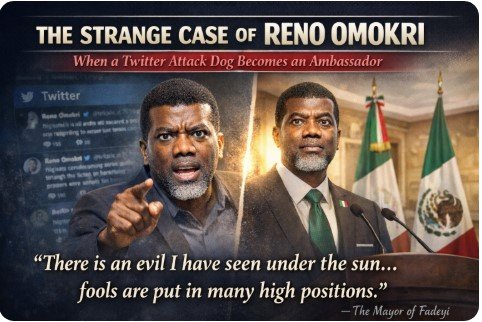
THE STRANGE STORY OF RENO OMOKRI – When a Foul-Mouthed Digital Political Attack Dog And Political Turn-coat Becomes an Ambassador
THE STRANGE STORY OF RENO OMOKRI – When a Foul-Mouthed Digital Political Attack Dog And Political Turn-coat Becomes an Ambassador [By Dr Ope Banwo, Mayor Of Fadeyi and Founder, Naija Lives Matter Org]
King Solomon, the wisest man who ever lived, once wrote something in Ecclesiastes that has puzzled readers for centuries. He said: “There is an evil I have seen under the sun… fools are put in many high positions, while the capable are pushed aside. I have seen slaves riding on horseback while princes walk on foot like slaves.” — Ecclesiastes 10:5-7
When Solomon wrote those words thousands of years ago, he probably did not imagine a future world with Twitter, hashtags, and digital political mercenaries.
But if the old king were alive today and scrolling through Nigerian politics, he might simply nod his head and say:
“Yes… this is exactly the strange thing I warned you about.”
Because only in a place where Solomon’s ancient observation still holds true can a man build his public reputation as one of the most aggressive and combative political voices on social media… and then suddenly emerge as His Excellency, Ambassador of the Federal Republic of Nigeria.
Ladies and gentlemen, welcome to the curious diplomatic story of Reno Omokri — Nigeria’s newest ambassador to Mexico, and perhaps the first ambassador in modern history who still behaves like a full-time Twitter campaign marshal.
The recent appointment of Reno Omokri as Nigeria’s Ambassador to Mexico should have been an opportunity for transformation—a moment for a controversial political commentator to shed the persona of an online political enforcer and embrace the discipline, restraint, and national representation required of diplomacy.
Instead, what Nigerians continue to witness is something deeply troubling.
The same man who has spent years operating as one of the most aggressive and combative political voices on Nigerian social media appears determined to continue behaving exactly the same way—even after being appointed ambassador.
Every day on Twitter (or X), Reno Omokri continues to attack critics of government policy, insult political opponents, and defend every government action as if he were still a campaign spokesman or a party media operative.
But an ambassador is not a party spokesman.
An ambassador is not a political influencer.
An ambassador is not a digital enforcer sent to silence critics.
An ambassador represents the entire nation.
And that distinction appears lost in the current spectacle.
The Difference Between a Campaigner and a Diplomat
Politics is combative. Diplomacy is measured.
Political campaigners fight.
Ambassadors reconcile.
Political commentators defend their party.
Ambassadors represent their country.
When a person is appointed ambassador, the expectation is simple: They rise above the daily noise of partisan battles and begin to operate with the restraint, maturity, and neutrality that the role demands.
But Reno Omokri’s online conduct suggests that he still sees himself primarily as a political combatant, not as a representative of the Nigerian state.
That is a dangerous misunderstanding of diplomatic responsibility.
Diplomacy Requires Decorum
Across the world, ambassadors operate within a well-understood culture of decorum.
They avoid unnecessary political insults.
They refrain from partisan warfare.
They speak with care, because every word can affect international perception.
Imagine the U.S. ambassador to France spending his days insulting American opposition figures on Twitter.
Imagine the British ambassador to Canada attacking domestic critics online daily.
It would be considered undiplomatic and inappropriate.
Yet this is precisely the behavior Nigerians are witnessing.
Instead of projecting maturity and national unity, the tone of Reno Omokri’s public commentary often resembles the same aggressive political activism that defined his online presence before his appointment.
The Irony of the Appointment
Some political observers have suggested that Reno’s appointment to Mexico may have been intended to move one of the government’s most controversial online defenders away from Nigeria’s domestic political space.
In other words, diplomacy as relocation.
But if that was the intention, it has not worked.
Because the online behavior has not changed.
The tone remains the same.
The targets remain the same.
The hostility remains the same.
The only difference now is that the person engaging in these daily political battles is officially a representative of the Nigerian state abroad.
That should concern anyone who cares about the dignity of Nigeria’s diplomatic service.
When Political Culture Collides with Diplomatic Culture
Nigeria’s diplomatic corps historically consisted of career diplomats—individuals trained in the delicate art of international engagement.
These professionals understood that diplomacy requires patience, restraint, and the ability to represent the nation rather than a political faction.
But when political culture begins to dominate diplomatic appointments, the results can be awkward.
The habits of partisan politics do not easily translate into the discipline of diplomacy.
A digital political warrior cannot simply wake up one morning and become a statesman without first abandoning the instincts of online political warfare.
And until that transformation happens, the result is confusion:
Is the person speaking as a diplomat, or as a political operative?
The Responsibility of Representation
Ambassadors carry the image of their nation with them.
Their words matter.
Their conduct matters.
Their tone matters.
When an ambassador speaks publicly, they are no longer just a private citizen or a partisan commentator.
They are a symbol of the state.
Which is why the continued spectacle of aggressive online political commentary from someone occupying such a role raises legitimate questions about whether the gravity of that responsibility has truly been understood.
A Simple Question
The question Nigerians must ask is simple:
Can someone simultaneously function as a hyper-partisan online political enforcer and a neutral diplomatic representative of the Nigerian nation?
Because those two roles require fundamentally different instincts.
One thrives on confrontation.
The other requires restraint.
One fights political battles.
The other builds diplomatic bridges.
If Nigeria wants its ambassadors to command respect internationally, then the standards of diplomacy must apply—even to those who once thrived in the chaos of political social media.
The Mayor’s Final Thought
Nigeria deserves ambassadors who elevate the country’s image—not personalities who continue to operate as if they are still campaigning in the trenches of domestic political warfare.
Diplomacy is not Twitter combat.
It is the quiet, disciplined work of representing a nation with dignity.
And until that distinction is fully understood, the line between political activism and diplomatic responsibility will remain dangerously blurred.
Ope Banwo
The Mayor Of Fadeyi
Founder, Naija Lives Matter Organization
A Non-Aligned Political Commentator