
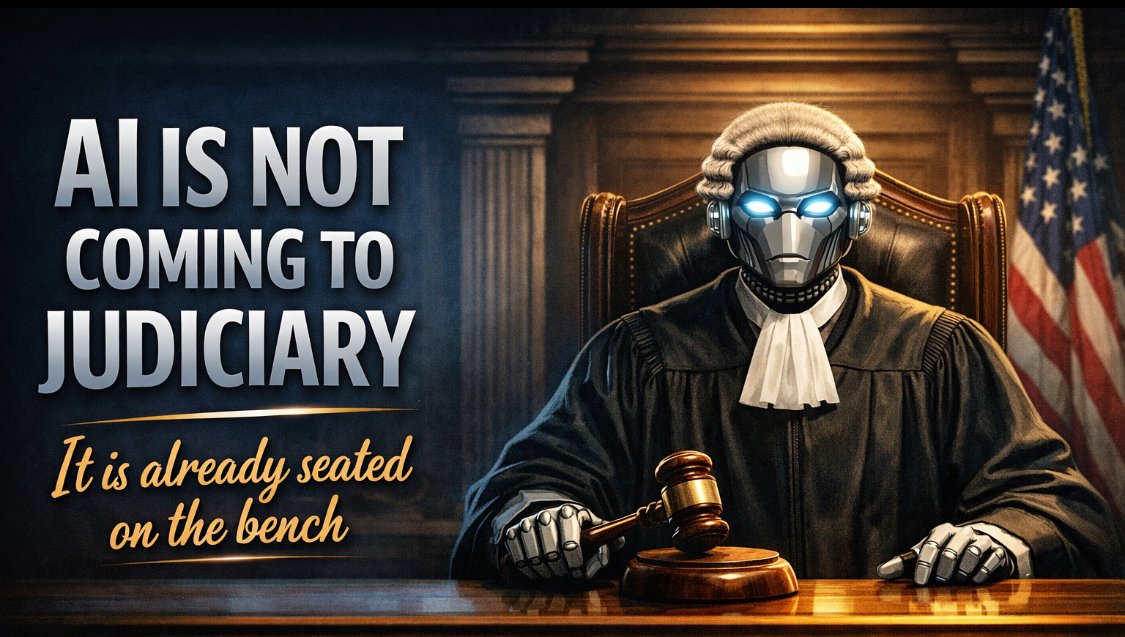
Lawyers, Judges, The Judiciary And The Inevitability Of Artificial Intelligence
LAWYERS AND JUDGES, READY OR NOT, AI HAS ALREADY INFECTED THE JUDICIARY AND SPREADING FAST – As Clerks, Litigators — and Yes, Even as Judges (By Dr Ope Banwo, Attorney & Mayor Of Fadeyi)
My dear colleague, it’s time to accept that whether the legal profession likes it or not, Artificial Intelligence has already crossed the courtroom threshold.
This is no longer a future-tense debate.
Across multiple jurisdictions today, AI systems are actively supporting — and in some cases directly influencing — judicial outcomes. Not in theory. In practice.
What started as simple legal research tools has evolved into a full-stack judicial assistant ecosystem: AI now acts as court clerks, paralegals, litigators, and even quasi-judges. The bad news is this is only the beginning
Let’s break this down with real-world examples.
🌍 The Global Reality: AI Is Already Embedded in Courts
Several countries have formally integrated AI into their justice systems to handle overwhelming caseloads, accelerate filings, assist rulings, and reduce administrative bottlenecks.
Here are verified, operational examples:
- China — Operates one of the world’s most advanced “Smart Courts” systems. AI tools automatically analyze evidence, recommend applicable laws, draft judgments, and manage filings. Reported outcomes include cutting judicial workload by over one-third in many regions.
- Brazil — Runs more than 140 AI projects across its judiciary, focused on mass litigation management, document classification, and procedural automation. While Brazil avoids AI in criminal adjudication, it heavily deploys it in civil and administrative matters to clear backlogs.
- Colombia — Made global headlines when a judge openly cited AI assistance in a ruling involving a child’s medical rights. The country is now aligning judicial AI usage with ethical frameworks promoted by UNESCO.
- Argentina — Uses a virtual legal assistant called Prometea to draft opinions, prepare filings, and accelerate case processing. Productivity gains in some courts reportedly jumped by multiples.
- Morocco and Tanzania — Apply AI primarily for courtroom transcription, translation, and record digitization, dramatically improving access and turnaround times.
- In Europe, pilot systems are active in the United Kingdom, Netherlands, and Latvia, mostly centered on legal research, document automation, and case triage.
This is not experimental lab work. These are production systems running inside real courts.
⚖️ Where Exactly Is AI Being Used?
Let’s categorize it plainly.
1. AI as Court Clerks
This is the most mature deployment as of today.
AI already handles:
- Case intake and routing
- Automatic scheduling
- Evidence indexing
- Transcription and translation
- Filing validation
- Deadline tracking
In many jurisdictions, what used to require rooms full of junior clerks now happens in seconds.
Result: Faster courts, fewer administrative errors, lower operating costs.
2. AI as Paralegals
Here, AI performs:
- Legal research across millions of precedents
- Statute comparison
- Drafting motions and opinions
- Summarizing case law
- Highlighting inconsistencies in arguments
In China and Argentina especially, AI routinely prepares first drafts of rulings that judges later review.
Human still signs.
But AI writes first.
Let that sink in.
3. AI as Litigators (Yes — Really)
In several systems, AI now assists prosecutors and defense teams by:
- Predicting case outcomes
- Suggesting litigation strategies
- Identifying winning precedents
- Modeling sentencing ranges
- Stress-testing arguments
In effect, AI is becoming a silent co-counsel — advising both sides simultaneously.
The asymmetry no longer lies in who hires the smartest junior associate.
It lies in who integrates AI better.
4. AI as Judges (The Line Is Already Blurred)
No country officially allows AI to replace human judges outright — yet.
But in practice, AI already:
- Recommends verdict frameworks
- Proposes sentencing ranges
- Flags credibility issues
- Ranks legal relevance
- Drafts final decisions
When a judge largely adopts AI-generated reasoning, edits lightly, and signs?
Functionally, AI just co-authored that judgment.
Colombia’s case made this explicit. China’s system operationalizes it at scale.
The robe may still be human.
The logic increasingly is not.
⚠️ The Ethical Elephant in the Courtroom
This rise has not come without serious concerns:
- Algorithmic bias
- Lack of transparency (“black box justice”)
- Data quality issues
- Due process implications
- Accountability when AI-assisted rulings go wrong
That is why countries like Colombia are adopting UNESCO-style ethical guardrails emphasizing:
- Human oversight
- Explainability
- Auditability
- Fairness
- Responsibility
But regulation is playing catch-up to deployment.
Technology moved first. Law is now scrambling behind.
🧠 The Bigger Message for Lawyers and Judges – NO NEED TO PANIC
Dear colleague , here is the uncomfortable truth:
AI will not replace judges.
But judges who understand AI will replace judges who don’t.
AI will not replace lawyers. But lawyers who deploy AI will replace lawyers who refuse to.
The judiciary is quietly being re-architected — not by legislation, but by software.
Those waiting for formal announcements will wake up one day to discover the transformation already completed.
🔚 Final Word
Ready or not, AI is no longer knocking on the courthouse door.
It is already seated inside — drafting filings, organizing dockets, shaping arguments, and influencing judgments.
The only remaining question is:
Will your legal system lead this change, regulate it, or be disrupted by it?
Because neutrality is no longer an option.
📘 Cementing Your Edge: Get the book: “The Attorney Meets ChatGPT”
If you’d like a practical, lawyer-friendly deep dive into how AI (especially ChatGPT) fits into real legal workflows, I recommend my book:
This book answers 100 tough questions EVERY LAWYER will like ot ask about Artificisl Intelligence in the law practice
This book is now Available everywhere via:
- opebanwo.net (search my catalogue to find it)
- Amazon
- Barnes & Noble
- Kobo.com and over 50,000 bookstores globally
- The book walks through interactive questions and answers for Ai hands-on applications, prompts, and mindset shifts designed specifically for legal professionals — not techies..
Dr Ope Banwo
Founding Partner,
Banwo and Igbokwe LLC
3568 Dodge Street . omaha, Ne 68131
tel: +14022080089
QQ88 cung cấp cổng truy cập giải trí online hiện đại, hỗ trợ đa thiết bị, vận hành mượt mà và đảm bảo sự thuận tiện khi sử dụng.
You are my aspiration, I own few web logs and sometimes run out from brand :). “The soul that is within me no man can degrade.” by Frederick Douglas.
QQ88 cung cấp môi trường giải trí trực tuyến được tối ưu hiệu suất, giúp người dùng thao tác nhanh và thuận tiện.
stonm.org socolive bán dâm
stonm.org socolive 18+
stonm.org socolive phim sex
A really good blog and me back again.
QQ88 cung cấp cổng truy cập giải trí online hiện đại, vận hành liền mạch, hỗ trợ đa thiết bị và dễ sử dụng.